Self-publishing has leveled the playing field, allowing independent authors to bypass traditional gatekeepers and deliver their book straight to the world. However, hybrid publishers have stepped in to muddy the waters, creating a kind of bridge between self-publishing and traditional publishing. Some are legally set-up businesses; others are outright scams. All impact authors’ earning potential.
Here, we compare self-publishing to hybrid publishing and break down why the latter may not serve authors as well as expected.
What Is Hybrid Publishing?
Many authors are easily overwhelmed by the technical hurdles of publishing platforms, and they seek out a guiding hand. Hybrid publishers step in to fill this need. They promise to handle your design, editing, and distribution.
The catch?
Most charge you thousands of dollars upfront and take a percentage—often 20% to 50%—of your earnings off the back end. The publisher controls your payouts, and it isn’t uncommon to hear of authors not receiving their earnings in a timely manner—or at all.
Hybrid publishers usually also claim rights to your work, depending on your contract, and if they go under, which they often do, authors usually find themselves lost, without any idea of who actually owns the rights to their book, how to receive the earnings owed to them, or how to take back control.
When considering the hybrid approach, you should ask yourself: If you’re paying for editing, design, and other production services anyway, why should the company be allowed to not only claim rights to your work but also dip into your earnings after publication?
Legitimate Hybrid Publishers vs. Predatory Vanity Presses
Hybrid publishers and vanity presses are often considered the same, which is no surprise since both charge authors for services upfront and claim rights to the work. In fact, vanity presses usually call themselves hybrid publishers! This makes it extremely difficult for authors who are set on going the hybrid route to choose a legitimate company.
True hybrid publishers are more selective than vanity presses about the books they accept. Some are invested in the success of the book and actually make an effort to ensure quality (they want to make as much money from your sales as possible). The cornerstone of legitimate hybrid publishing is that the author and publisher share the financial expenses and the rewards. If the hybrid publisher charges you for every service, from editing to marketing, AND shares your sales revenue, this is cause for concern.
Vanity presses, on the other hand, accept every book submitted to them and usually don’t care whether the book sells later. Their primary income is from authors paying for inflated, unprofessional services, and if the vanity press happens to make any money off the back end on sales, that’s just a bonus. That is, if they deliver at all. Many vanity presses disappear after the contract is signed and payment is sent.
The Self-Publishing Model: How to Maintain Full Rights, Royalties, and Control
By contrast, in a true self-publishing model, you pay for design, editing, and any other services you may need. You also retain all creative control. Once those services are completed, however, the files belong to you, and as long as you purchase your own ISBN, you’ll be listed as the publisher on record.
You own any printing and distribution accounts you set up, and you keep all earnings minus printer/distributor fees. You’ll have direct access to your sales reports and payouts will go straight to your bank account without someone else dipping into them.
Just keep in mind that not only are you responsible for all costs associated with preparing and publishing your book, but you’re also responsible for ensuring proper licensing for all images, fonts, and other elements you use. Self-publishing means you are the author and the publisher, so you have to be ready to think like a businessperson, not just a writer.
Which publishing model is best for you depends on your goals, budget, time, and the amount of work you’re willing to take on. Authors who wish to retain as much control as possible over their rights, earnings, and files would likely find the self-publishing route best, as long as they work with reputable services.
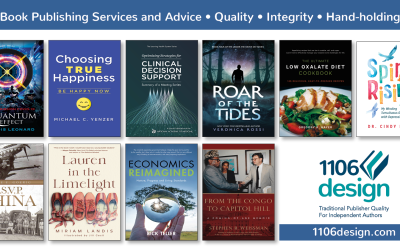
Pro tip: IngramSpark and KDP have generous help sections for those willing to learn how to use those platforms, but if you’re not tech savvy, that doesn’t have to sway you from the self-publishing route. At 1106 Design, we offer our customers guidance for setting up their accounts at IngramSpark and KDP, and we also provide title setup assistance (to the author’s own account) at the end of the project for all of our clients.
How Does Hybrid Publishing Compare to Traditional Publishing?
Unlike hybrid publishers, a legit traditional publisher doesn’t charge you anything. In fact, some offer you an advance against your future royalties upfront.
That said, there are caveats to traditional publishing:
- Authors receive a relatively small royalty percentage, if the book makes it to print at all. Traditional publishers assume all financial risk, handling all production aspects and securing printing/distribution. In return, they take most of the earnings to help recover their expenses.
- From enlisting an agent’s help to actually landing a deal to seeing the book in print—traditional publishing can take many years to achieve, if it ever happens.
- Traditional publishers purchase the rights to your book. They then have control of all editing and design decisions, when or if the book goes to print, and where it’s sold.
Our prior article shares a more in-depth look at traditional publishing.
7 Red Flags Authors Should Avoid
Before you hand over your manuscript to ANY company, here are a few red flags to watch out for:
- Rights Grabs: Certain rights-grabbing clauses may be disguised as “exclusive marketing partnerships” or the like. Others might outright state that they intend to claim rights to your work. Whether this is a problem for YOU will depend on your goals. You can expect traditional and hybrid publishers to claim certain rights, but if you’re hoping to self-publish, you’ll want to avoid those routes.
- Unclear Pricing or Terms: Some companies deliberately omit pricing information or make their terms of service (including cancellation, rights, payouts, and confidentiality clauses) overly complex. Contracts should use plain language.
- Aggressive Upselling and Spamming: Certain companies try to force you to purchase additional services beyond what you need/want and pressure you into acting fast instead of giving you time to consider. They often spam you with calls and emails, trying to bully you into action.
- Account Control: A publisher may insist on hosting the book under their KDP or IngramSpark account, making you dependent on them for payouts and sales reports. Again, this is mainly a red flag for authors who want to retain control and self-publish. If you don’t care about keeping control, then you may not have an issue with a publisher using their own accounts, but be sure you understand what that will entail.
- Required Book Purchases: Be wary of companies that require you to personally purchase a specific quantity of your own finished books. You should always have the option to buy author copies at wholesale cost, of course, but you should never be forced to do so.
- Lack of Positive Reviews: Experienced, credible companies typically display proof of their happy customers on their website and other third-party sites like the BBB. If you can’t find reviews, it can indicate the company is inexperienced or illegitimate.
- Unwillingness to Share Samples: You should be allowed to request examples of a company’s past work to see if it aligns with your expectations. If a company isn’t willing to share samples, it could mean they’re a scam.
Pro tips:
- Thoroughly read any contracts before you sign them, and if you’re confused by anything, ask for clarification and/or consult a lawyer.
- Research a company to see if they’re related to any scams or complaints. Websites such as Writer Beware, The Authors Guild, and The Alliance of Independent Authors can help you learn about the industry and vet potential services. You can also look up companies at the Better Business Bureau.
At 1106 Design, our philosophy has always been non-negotiable: You, the author, are the publisher. You should retain absolute control of your rights, accounts, files, and profits. Regardless of whether you go the self-publishing route, however, you should do your research so you can be an informed author, steer clear of the vanity press trap, and build an author business that you can be proud of. Contact us today to learn how we can help you succeed.