With the availability of text processing tools now available to everyone, book design has become a misunderstood craft. It’s not uncommon for book designers to receive a request to “convert my Word file into a PDF for the printer.” While there are certainly some so-called designers who will do just that, the result will be…um…just like your Word file and nothing like a real book.
Experienced book designers don’t just “click a button” that makes the text automatically snap into final form. We work line by line, word by word, and sometimes letter by letter to achieve optimal spacing between words and letters to maximize reading comprehension and minimize reader distractions.
Here are just a few of the issues book designers attend to during the formatting process to give your book a professional appearance:
The first step in designing the interior of your book is to create a sample chapter. A good book designer doesn’t use a template. We always choose fonts and images that are in keeping with your subject matter to give your book a unique (and appropriate!) look.
Normally, several samples will be developed, because there are multiple ways to design any book. These samples will include subtleties in the use of font styles and sizes that make a book look like a real book, and not a word-processed document. Once these initial concepts are presented, it’s necessary to work back and forth with the author/publisher on this sample until all the details are hammered out. Only then is the rest of the book layed out to match the sample.
Here are just a few of the things book designers attend to during the layout process:
We ensure facing pages end on the same baseline without the first line of a paragraph landing on the bottom of a page, or the last line of a paragraph landing on the top of a page. When the text doesn’t cooperate with these rules (which is often), we rework previous paragraphs and pages as needed.
We fix paragraphs that end in a word with less than five characters (including punctuation) or a word fragment (the stub end of a hyphenated word).
We banish “ladders” (too many hyphens in a row) and find and fix hyphenated compound words, both of which distract the reader.
We eliminate word stacks—when the same word falls one above the other on several consecutive lines of text.
We adjust any overly tight or loose lines that software often allows to slip through.
We watch for rivers of white in the text—when word spaces fall in a pattern that is distracting to the reader.
We eliminate hyphens at the bottom of a right-hand page so that the reader won’t have to hold a thought while the page is turned.
We make sure the last page of a chapter has at least four lines of text.
These items are only the beginning. Software out of the box only goes so far . . . it is this level of human intervention that turns your manuscript into typographic art, and when you see the results, we know you’ll agree that this time is well-spent.
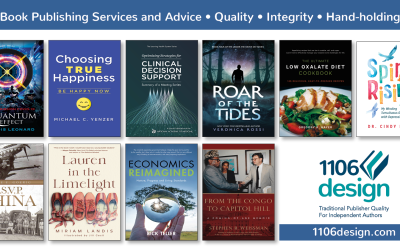
1106 Design works with authors, publishers, business pros, coaches, consultants, speakers . . . anyone who wants a beautiful book, meticulously prepared to industry standards. Top-quality cover design, beautifully designed and typeset interiors, manuscript editing, indexing, title consulting, and expert advice. All available from one convenient source. All offered with our most important service, hand-holding. Attractive pricing choices to fit almost any budget. Prompt, personalized service. Satisfaction guaranteed. We’ll take better care of you and your book than any “self-publishing company.” How may we help you? Post your comment here or email us using the Contact Us page.